
THE SCIENCE
Neuromuscular Adaptations and Performance in Runners
Performance in endurance sports is not determined only by aerobic capacity and metabolism, but also by the ability of the neuromuscular system to produce and manage force effectively.
Plyometric training is a specialized training method aimed at improving force production, rate of force development, and the efficient utilization of elastic energy.
Its primary mechanism is the stretch–shortening cycle, through which muscles and tendons store and reutilize elastic energy during movement.
In running, this mechanism affects:
- running economy
- ground contact time
- force production during propulsion
- movement stability
- neuromuscular efficiency
At the same time, plyometric training appears to improve the nervous system’s ability to activate motor units more effectively, contributing to force production with lower energetic cost.
These adaptations become particularly important in endurance events, where maintaining mechanical effectiveness under fatigue significantly influences final performance.
According to the literature, plyometric training represents an effective tool for improving neuromuscular function and athletic performance.
Explosive-strength training improves 5-km running time by improving running economy and muscle power
THE APPLICATION
How Plyometric Training Should Be Properly Applied
Plyometric training is not simply about “jumping.” Its structure determines the neuromuscular stimulus and the quality of the adaptations that will occur.
In practice, the goal is not exhaustion, but the production of high-quality movement through effective force utilization.
BASIC FORMS OF PLYOMETRIC TRAINING
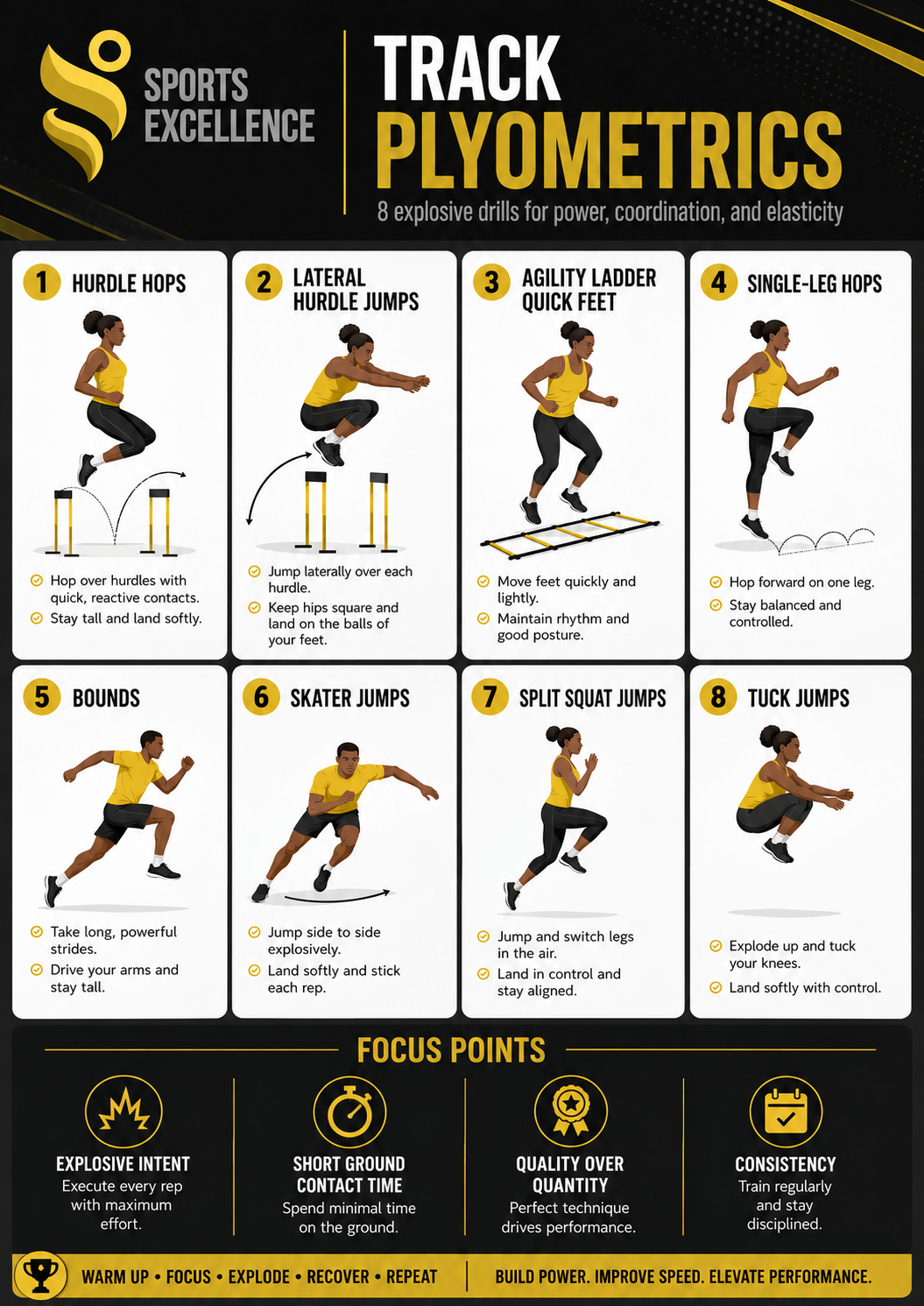
Jumps
- vertical jumps
- repeated short ground-contact jumps
- forward jumps
Goals:
- improvement of force production
- improvement of musculotendinous stiffness
- reduction of ground contact time
- improvement of movement stability and control
- more effective management of mechanical loads during running
Reactive Drills
- low hurdles
- quick ground contacts
- rhythm and neuromuscular coordination drills
Goals:
- faster motor unit activation
- improved coordination
- maintenance of movement efficiency
INJURY PREVENTION
Plyometric training does not seem to contribute only to performance improvement, but also to enhancing the runner’s resilience.
Improved neuromuscular control and the ability to manage mechanical loading may contribute to reducing injury risk, particularly when plyometric training is progressively integrated and properly structured within the training plan.
KEY PRINCIPLES OF APPLICATION
Plyometric training should:
- be performed 1–2 times per week
- be executed with high movement quality
- be applied when adequate recovery is available
- be progressively integrated into the training program
ΚΡΙΣΙΜΟ ΣΗΜΕΙΟ
Fatigue significantly reduces the quality of neuromuscular function.
Plyometric training:
- should not be performed under excessive fatigue
- requires high-quality execution
- requires control of movement mechanics
COACHING PRINCIPLE
Plyometric training aims to improve the quality of force production rather than simply increasing training load.
Essentially, it represents the mechanism through which force production and utilization are transformed into more effective movement and competitive performance.
Dimitrios Theodorakakos
Sports Director @sportsexcellence
Sports Excellence Team