
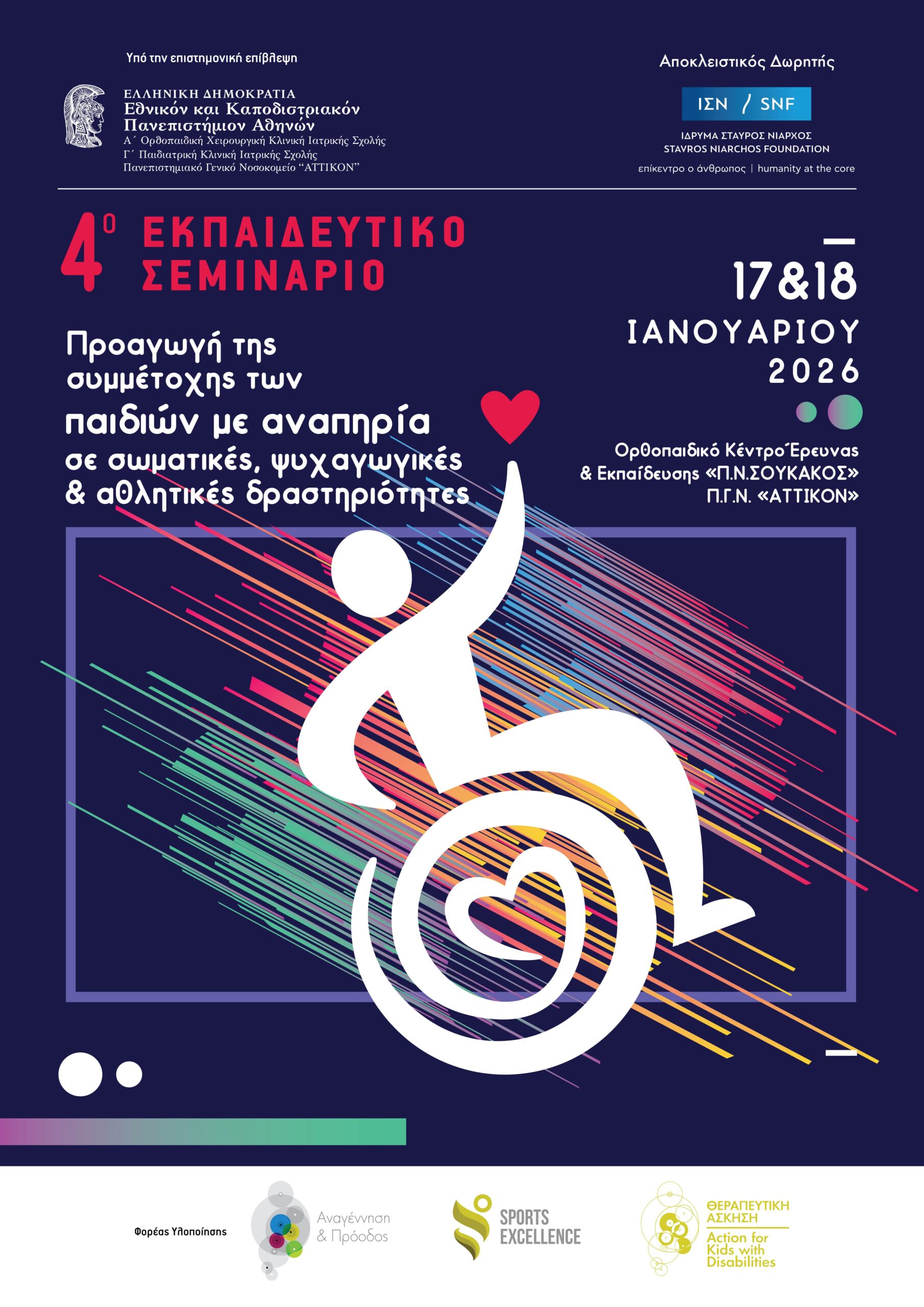
Online Seminar: Promoting the Participation of Children with Disabilities in Physical, Recreational, and Sports Activities
REGISTER HERE

Introduction:

Physical activity—through exercise, play, and sport—is vital for a child’s physical development, motor development, mental, emotional, and social well-being, as well as cognitive and academic performance. However, children with disabilities, including those with motor, cognitive, behavioral, and/or sensory impairments, face numerous barriers to their inclusion and full participation in physical, recreational, and sports activities.


Target Audience:

• Physicians
• Physiotherapists
• Occupational Therapists
• Speech and Language Therapists
• School Nurses
• Physical Education Teachers
• Adapted Physical Education Teachers – Coaches
• Special Education Teachers
• Psychologists
• Social Workers
• Other professionals involved in special education


Program Scope:

The aim of the Training Program is to provide participants with the necessary knowledge and skills to enable them to:

• identify limitations that lead to or result from a lack of physical exercise and activity
• design and recommend individualized and appropriate physical activity programs that promote participation in play, recreation, and sport


Objectives of the Training Program:

• To inform and raise awareness among participants about the importance of participation of children with disabilities in physical, recreational, and sports activities.

• To provide participants with the necessary theoretical background to identify and assess not only the basic clinical characteristics of children with motor, developmental, and cognitive-perceptual difficulties, but also specific medical and functional conditions that affect and hinder participation in activities. This knowledge will enable them to recommend safe and appropriately adapted activities in terms of type (play or sport), equipment, technical characteristics, and time parameters, with the ultimate goal of maximizing participation, optimizing performance, and preventing injuries.

• To equip participants with knowledge on identifying and utilizing appropriate resources and information that can be provided within the family and school environment in order to remove barriers to the participation of children with disabilities in physical, recreational, and sports activities.

• To develop the necessary competencies that will allow participants to support healthcare, educational, and community organizations in offering physical activity opportunities for children with disabilities.

Psychological Resilience in the Special Education System
Learning Objectives: Understanding the concept of psychological resilience and its role within the special education system.


Cerebral Palsy: (Psycho)Somatic Impairments that Limit Activity
Learning Objectives: Understanding the psychosomatic impairments associated with cerebral palsy and how they limit activity.


Neurogenetic Disorders: (Psycho)Somatic Impairments that Limit Activity
Learning Objectives: Learning about the most common neurogenetic disorders and recognizing their clinical presentation and key symptoms that disrupt physical activity.


Chromosomal Syndromes: (Psycho)Somatic Impairments that Limit Activity
Learning Objectives: Learning about the most common chromosomal syndromes and recognizing their clinical presentation and key symptoms that disrupt physical activity.


Common Mental Disorders in Childhood and Adolescence: Psychobehavioral Impairments that Limit Activity
Learning Objectives: Recognizing common mental disorders in childhood and adolescence and understanding the impact of psychobehavioral impairments on physical activity.


Autism Spectrum Disorder: (Psycho)Somatic Impairments that Limit Activity
Learning Objectives: Recognizing the clinical presentation and key symptoms of Autism Spectrum Disorder (ASD) that disrupt physical activity.


Training Program for Health Professionals on the Management of Cases of Physically Abused Children
Learning Objectives: Understanding the principles and practices for managing cases of physically abused children by health professionals.


Visual Impairments and Blindness: Sensorimotor Impairments that Limit Activity
Learning Objectives: Recognizing the clinical presentation and key characteristics of visual impairments that affect movement, and identifying the related medical conditions.


Medical History Taking
Learning Objectives: Learning how to take a medical history through the completion of a specialized form for children with disabilities, based on pre-participation medical history forms for individuals with disabilities in sports activities and the Special Olympics.


The Use of the F-Words in the Assessment and Goal Setting of Children with Disabilities
Learning Objectives: Understanding how the F-words are used in assessing the clinical profile of children with disabilities and in setting goals for therapeutic programs.


Development of Specially Adapted, Individualized, and Safe Physical Activity Programs for Children with Disabilities
Learning Objectives: Understanding and developing the ability to design specially adapted, individualized, and safe physical activity programs for children with disabilities.


Development of Specially Adapted, Individualized, and Safe Physical Activity Programs for Children with Disabilities
Learning Objectives:
(a) Designing modified exercise and sports protocols
(b) Implementing specially adapted and protective equipment for effective, efficient, and safe participation


Disability and Sport
Learning Objectives: Understanding the relationship between disability and sport, as well as opportunities for participation and inclusion.


24-Hour Movement Guidelines for Children
Learning Objectives: Knowledge and understanding of 24-hour movement/activity guidelines and the use of specialized activity checklists to identify barriers and promote participation in physical activities.


Understanding Autism Spectrum Disorder – Management and Approach to Autistic Individuals: New Evidence
Learning Objectives: Guidelines for approaching and supporting autistic individuals, incorporating new evidence and practices.


Promoting Sexual Health in Individuals with Disabilities
Learning Objectives: Informing and training professionals on the importance of sexual health, including hormones, the biological onset of puberty, and the transition from childhood to adolescence and from adolescence to adulthood.


New Evidence-Based Therapeutic Interventions for Promoting Participation through Physical, Recreational, and Sports Activities
Learning Objectives: Exploring new developments in the rehabilitation of children with disabilities aimed at promoting participation in a wide range of activities.

CLICK HERE FOR THE FULL PROGRAM

Privacy Overview

This website uses cookies so that we can provide you with the best user experience possible. Cookie information is stored in your browser and performs functions such as recognising you when you return to our website and helping our team to understand which sections of the website you find most interesting and useful.