

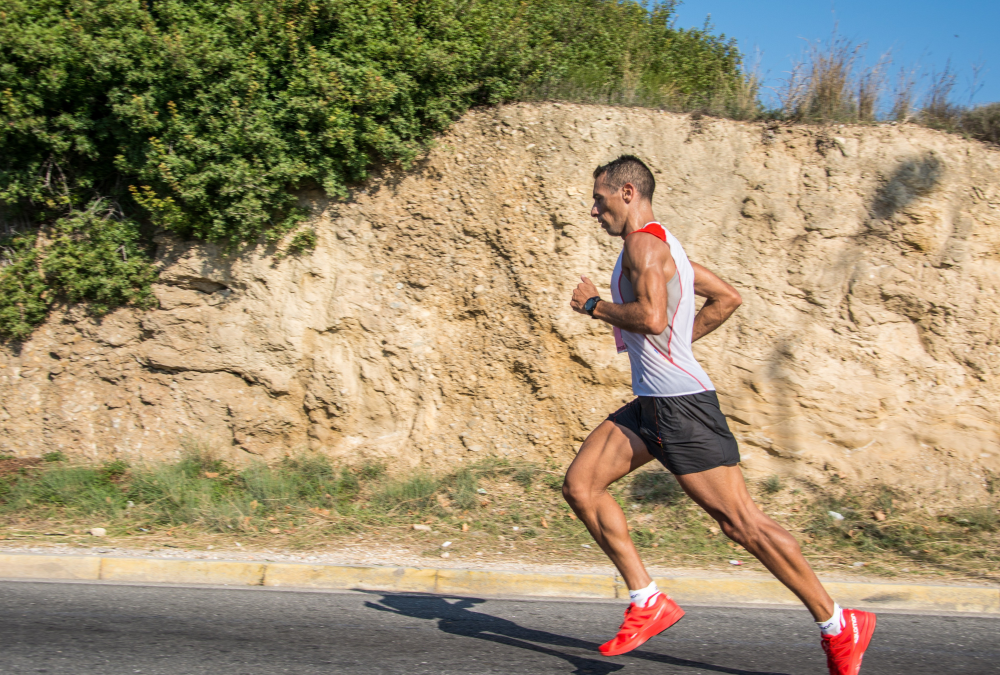
Running to Excellence
Running Economy: The Key Determinant of Performance
The Science
Determinants of Running Economy
Running economy is one of the most important determinants of endurance performance and reflects the energy cost required to maintain a given running speed. In simple terms, it describes how “economically” a runner moves at a given pace.
In contrast to VO₂max, which defines the upper limit of aerobic capacity, running economy determines how efficiently this capacity is utilized during movement. Two athletes with similar VO₂max values may show significant differences in performance due to differences in running economy.
Running economy is influenced by a combination of factors, including:
- mechanical factors (running technique, stride length and frequency)
- neuromuscular factors (coordination and muscle activation patterns)
- musculotendinous properties (tendon stiffness and elasticity)
- metabolic factors (substrate utilization and energy efficiency)
Particular importance is given to the ability of the body to effectively utilize elastic energy through the stretch–shortening cycle, reducing the overall energy cost of movement.
At the same time, neuromuscular adaptations improve load distribution and reduce unnecessary movements, contributing to greater efficiency.
According to the literature, running economy is one of the strongest predictors of endurance performance, regardless of VO₂max levels.
Running economy: measurement, norms, and determining factors
The Findings
How Running Economy is Improved in Practice
Based on scientific evidence, improvements in running economy result from the combined effect of technique, neuromuscular function, and strength training.
For runners preparing for 6 km and 10 km races, such as the SNF Nostos Run, improving running economy translates into the ability to sustain a higher pace with lower energy cost.
The practical application is based on three main pillars:
Running Technique
Improving running technique focuses on:
- optimizing stride frequency (cadence)
- reducing ground contact time
- improving body and pelvic alignment
Even small adjustments in technique can lead to significant reductions in energy expenditure.
Neuromuscular Activation (Drills)
Running drills contribute to:
- improved coordination
- activation of the appropriate muscle groups
- stabilization of movement patterns
Examples:
- skipping
- high knees
- butt kicks
Strength Training
Strength training, particularly targeting the posterior chain, contributes to:
- improved force production
- reduced energy loss
- improved movement mechanics
- injury prevention
The combination of strength and plyometric training appears to have a significant impact on running economy.
Running economy is not improved through excessive effort, but through improving movement efficiency.
Integration into Performance
Running economy:
- allows the maintenance of higher speeds
- reduces overall energy demand
- delays the onset of fatigue
and serves as the link between physiological capacity and actual race performance.
Performance does not depend solely on how much oxygen a runner can utilize, but on how efficiently that oxygen is used.